Catherine of Siena
-
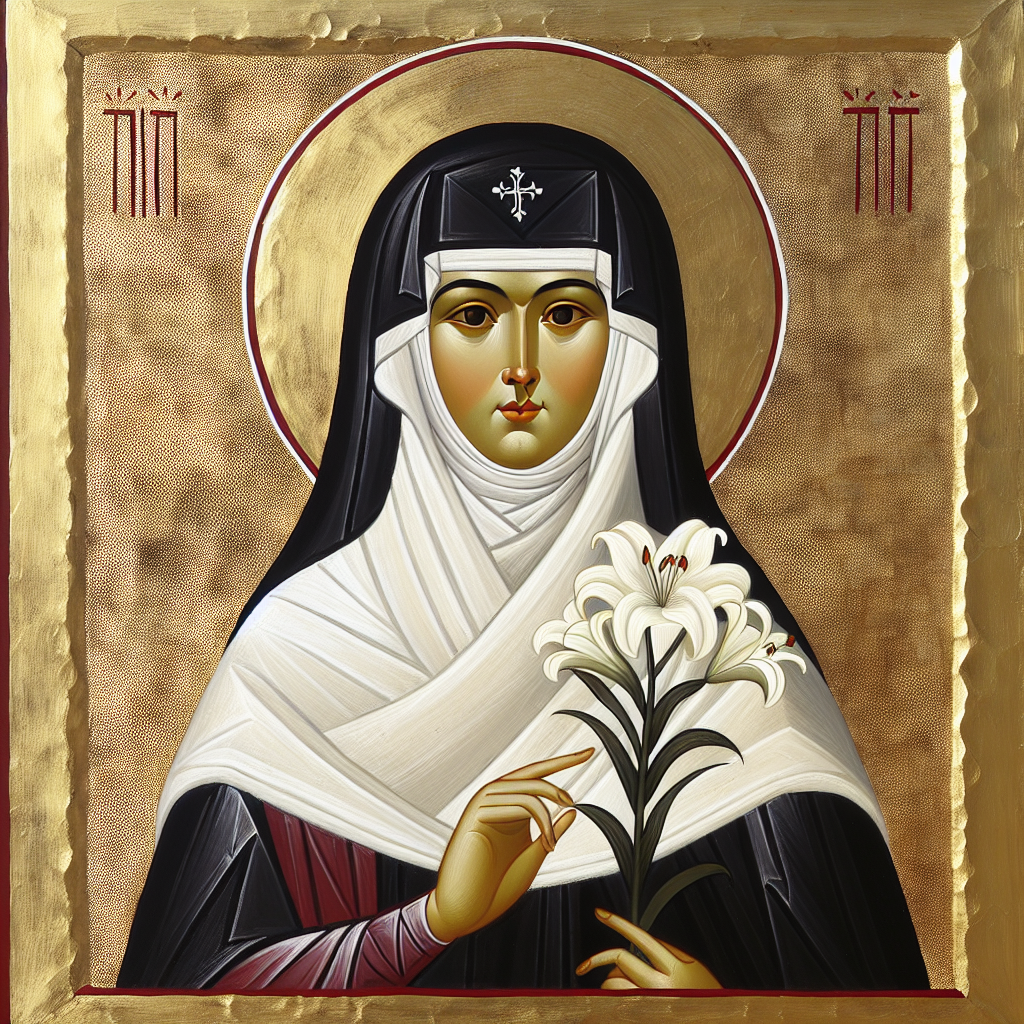
We are on to entry #35 in project #EuropeanBios, Saint Catherine of Siena. A strong-willed and almost supernaturally charismatic woman, she contributed to world-changing geopolitical shifts through sheer force of personality, not always in what I'd consider to be a positive way!
-
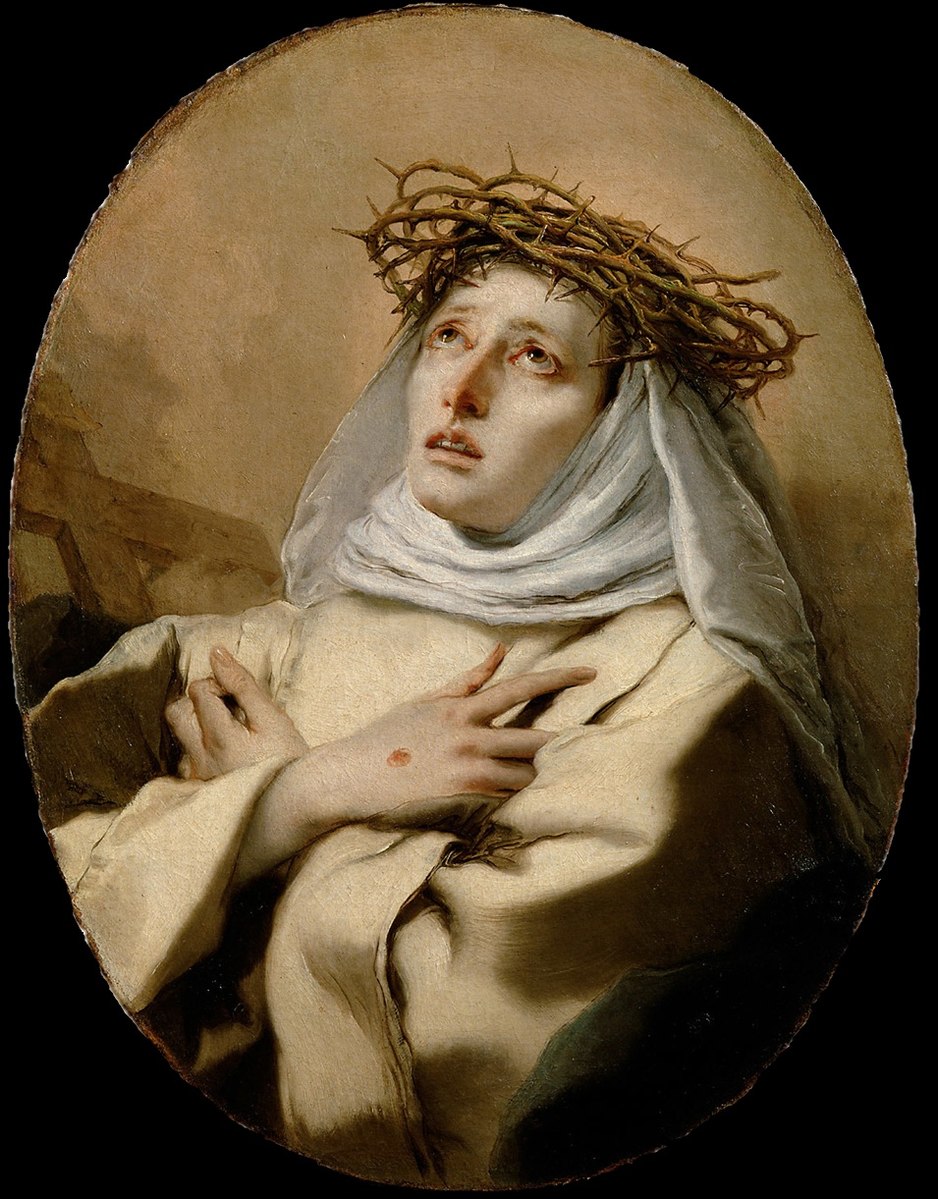
Saint Catherine of Siena, by Giovanni Battista Tiepolo, c. 1746 Saint Catherine of Siena by Giovanni Battista Tiepolo, c. 1746, public domain -
Catherine was born in Italy in 1347 to rich parents, rich parents being common to all of the saints I've covered, including Paul, Augustine of Hippo, Benedict, and Thomas Aquinas. And like most of the saints, with the exception of Augustine, she was pretty dull.
-
As always my take on these people is colored by reading only one biography and this one had a very strong point of view, which is that Catherine was awesome, that god is real, and that all her miracles actually happened. I have tried my best to correct for this bias to unreality.
-
Catherine is famous for having visions, which launched her into a state of ecstasy in which she was physically immobile and oblivious to her surroundings, including pain. To a modern reader these visions, the basis of her divinity, sound a lot like some neurological condition.
-
Catherine was by all accounts a pretty weird kid. She had her first vision around age 5 and soon dedicated herself to be a "bride of Christ", a relationship she took extremely literally. She skipped out on chores and once ran away from home to pray and commune with god.
-
Her family was big -- her mother had 25(!) children, only half of whom survived infancy -- and they had expectations of her, in particular who she should marry, but she stubbornly insisted she was already married to Jesus and eventually convinced her family to go along with this.
-
She was, like all the saints, tremendously charismatic. It's fun but ultimately fruitless to wonder why that might be. Why should the ravings of Catherine, or Paul, or Augustine be so convincing to so many of their contemporaries? Was it personality, delivery, attractiveness?
-
We don't know, and even at the time probably nobody knew. Today I can easily think of some politicians who are rivetingly charismatic, who motivate millions to act and vote, when the same words coming from somebody else would cause no reaction. It's a mysterious quality.
-
Whatever it was about her, Catherine attracted followers from an early age. She personally converted hundreds of people to belief in her divine inspiration, through long conversations. She treated them as a large, extended family, and many of them referred to her as "mother".
-
Not everyone was a fan though. A frequent occurrence in her life was people becoming jealous of her followers and fame and trying to tear her down as heretical or promiscuous, those being considered roughly equally damning at the time. She often won her accusers over to her side.
-
She is famous for a lot of miracles most of which do not bear up to any kind of scrutiny. The most frequent one is that she never ate anything except the holy sacrament, i.e. bread and wine at mass (which would usually be weekly). There are two reasons not to take this seriously.
-
The first was: she didn't do it all the time. She took breaks in which she ate normal food, mostly vegetables and fruit. The second is: she took sacrament *constantly*, multiple times a day. You can probably live on bread and wine alone for a while if you eat enough of it.
-
However, it clearly wasn't good for her. She was incredibly thin and frail and died of a stroke aged 33. Her followers wanted to take her body back to Siena but couldn't get permission so instead they cut her head off and smuggled it out, then put it on display, forever. Yikes.
-
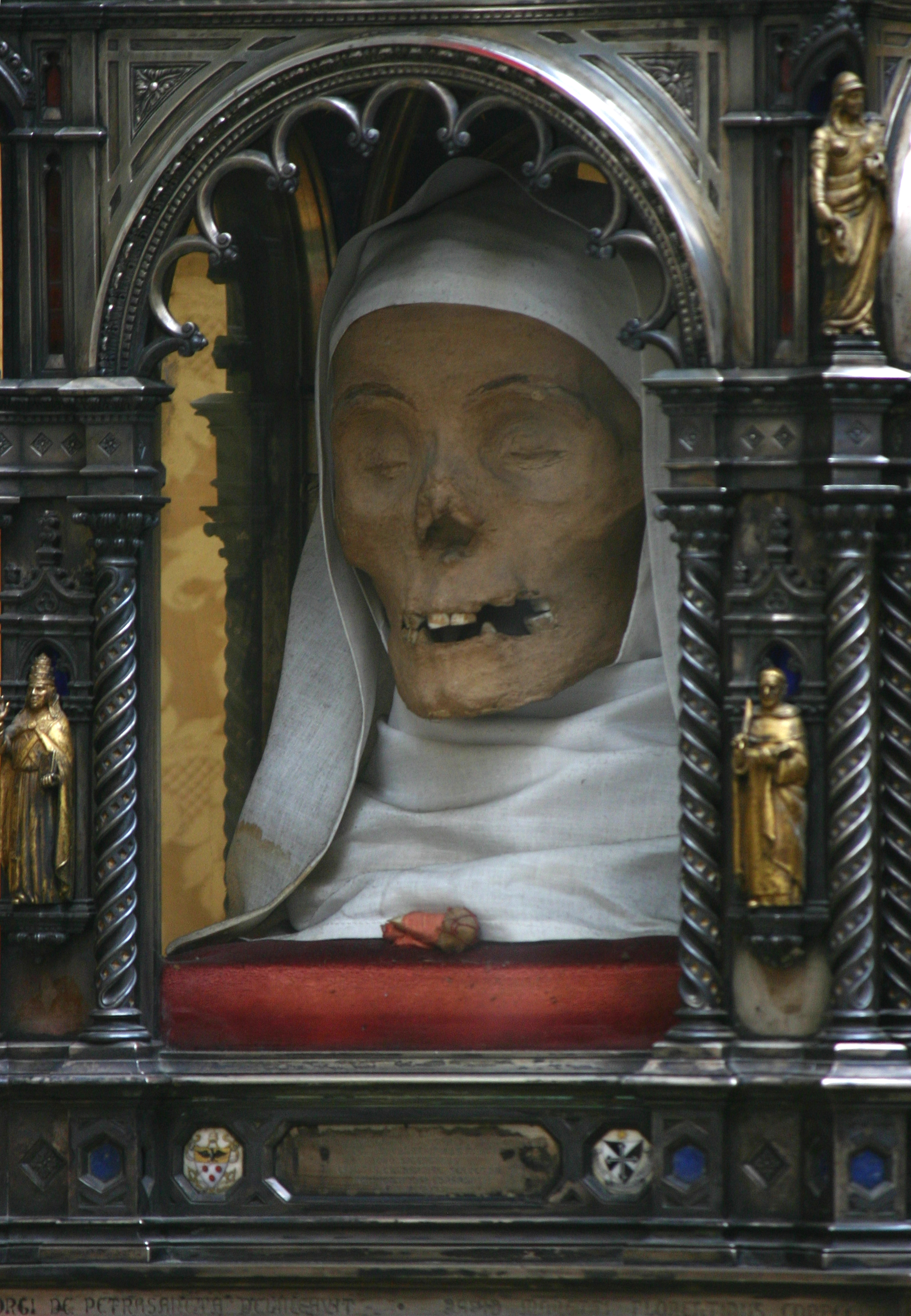
The preserved head of Saint Catherine of Siena in its reliquary at the Basilica of Santa Maria sopra Minerva in Rome Head of Saint Catherine of Siena by Giovanni Cerretani via Wikimedia Commons (CC BY-SA 3.0) -
Catherine's real accomplishment was using her enormous popularity and fame to sway geopolitics. She was instrumental in convincing Pope Gregory XI to move the seat of the catholic church back to Rome from Avignon, where it had been for 60 years. This was a huge deal!
-
Getting the papacy back to Rome from France involved fighting a long and complicated series of wars. Catherine helped by brokering peace between Rome and various city-states, again primarily through sheer force of personality when talking to political leaders.
-
But as far as Catherine was concerned getting the pope back to Rome was just the start. She wanted to start another crusade, retake Jerusalem, and wipe out muslims. Not great, Cathy! Fortunately this was a bridge too far even for her enormous influence and it went nowhere.
-
She also used her influence to shore up support for the new pope, Urban VI, across Italy, which consisted of a mess of warring city-states at the time. Urban turned out to be kind of a vicious bastard later on, torturing and killing cardinals who opposed his rule. Whoops!
-
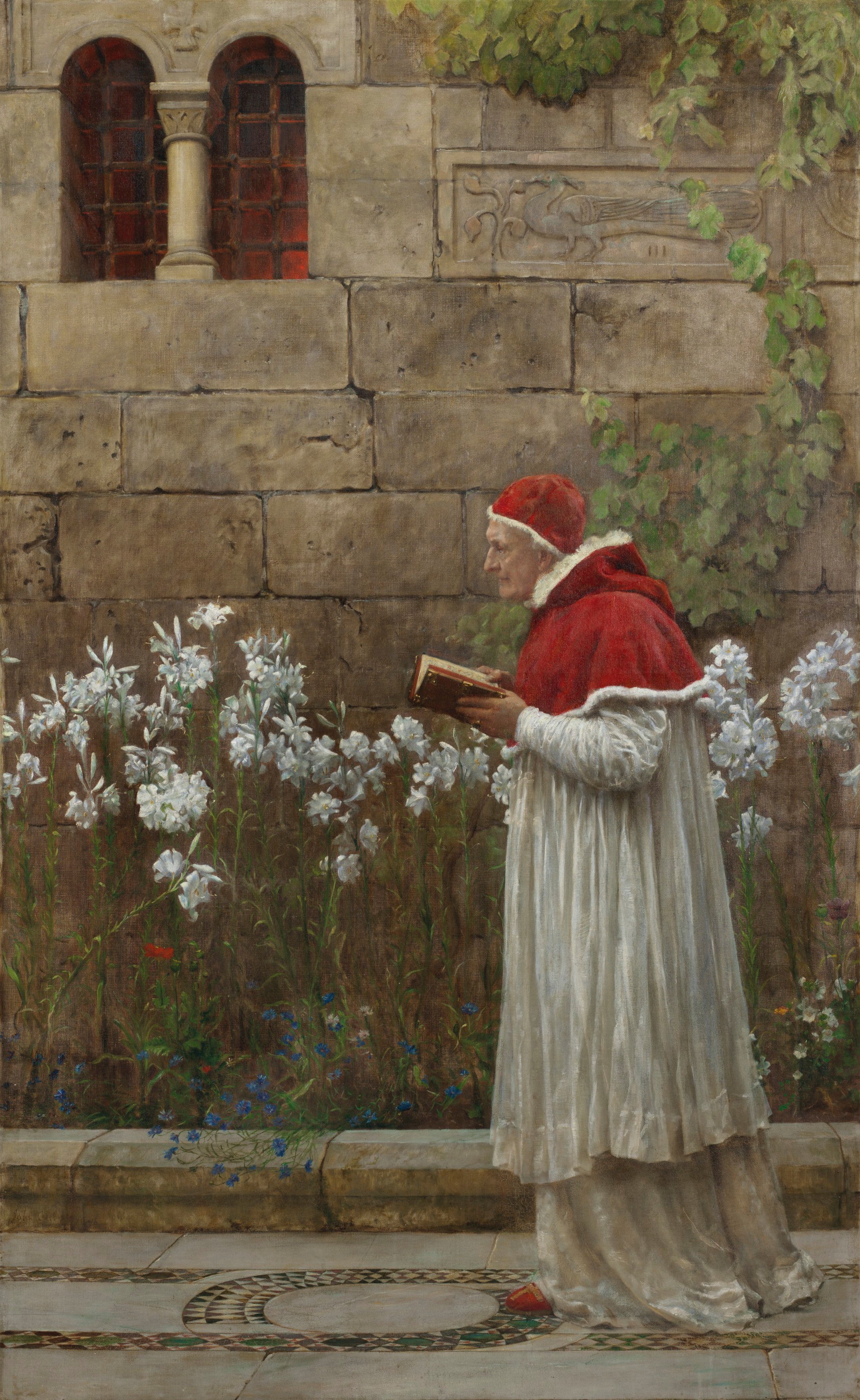
Pope Urban VI, by John Collier, 1896 Pope Urban VI by John Collier, 1896, public domain -
Overall Catherine's legacy is mixed. She was undoubtedly an amazingly charismatic person who overcame enormous hurdles of sexism to become a true political player in her time, but the things she used that power to do were neutral at best, islamophobic and genocidal at worst.
-
Entry #36 will probably be in just a few days, and it's Joan of Arc, thankfully the last saint I'll be covering because their bios are always weirdly credulous about miracles in a way that calls all of their historical value into question.
- Previously: Geoffrey Chaucer
- Next: Joan of Arc
- Full list
Text and images copyright © 2020-2023 Laurie Voss
except where indicated
except where indicated